
Have you ever found yourself in the middle of an argument with your partner and thought, "How did we end up here again?" Maybe this time it's about the dishes, last week it was about money, and the week before that it was about not spending enough time together. The topics seem different, but somehow the arguments feel remarkably similar. You both know how they're going to go, and yet neither of you seems able to stop them.
For many couples, this becomes one of the most frustrating parts of their relationship. It's not just the disagreements themselves, but the feeling that nothing ever really gets resolved. You might apologize, agree to move forward, or decide it's better to stop talking about it. Things feel okay for a while, until something happens and you're right back in that familiar place. Over time, it's easy to start wondering whether your partner really understands you, whether anything will ever change, or whether this is just what your relationship has become.
When the Argument Isn't Really About the Argument
One of the things I often explore with couples in Emotionally Focused Couples Therapy (EFCT) is what happens between them when things become difficult. We tend to focus on what we're arguing about, which makes sense. Those issues are important. But sometimes what keeps an argument going has less to do with the actual disagreement and more to do with how each person is experiencing the other in that moment.
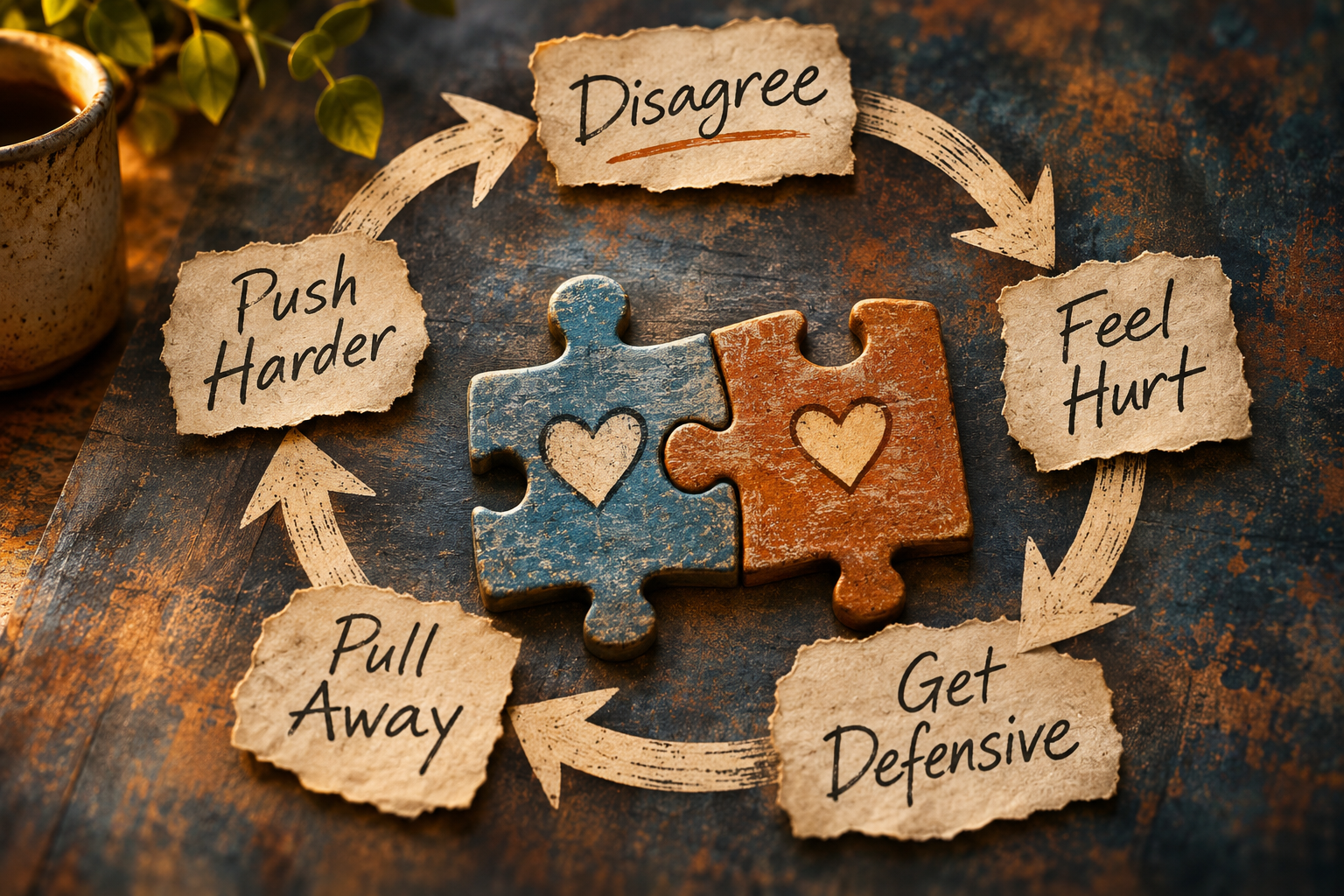
Imagine one partner has been feeling disconnected and wants more time together. They bring it up, but it comes out sounding like a complaint: "You never want to spend time with me anymore." The other partner hears criticism and immediately feels like they're failing again. They become defensive or withdraw from the conversation. Now the first partner feels even more alone and pushes harder to be heard, while the second partner pulls further away.
Before long, both people are frustrated, hurt, and feeling misunderstood. One may be thinking, "Why don't you care enough to talk to me?" while the other is thinking, "Why does everything I do seem to be wrong?"
Neither person may realize how much their reactions are affecting the other. They're often trying to manage their own hurt, fear, or frustration, but those reactions end up creating more of the very thing they're trying to avoid.
In EFCT, we call this a negative interaction cycle. It's the pattern couples can get caught in when they're struggling to feel emotionally connected and secure with each other.
Looking Beneath the Reactions
What I appreciate about EFCT is that we don't stop at the argument itself. We get curious about what's happening underneath the frustration, defensiveness, or silence. Sometimes the partner who seems angry is actually feeling unimportant or afraid of losing the connection. The partner who shuts down may not be indifferent at all, but overwhelmed, discouraged, or afraid of making things worse.
These aren't always easy feelings to recognize, much less share. It's often easier to say, "You never listen to me," than to say, "I miss feeling important to you." It's easier to walk away from a conversation than to admit, "I feel like I'm letting you down, and I don't know what to do."
When couples begin to understand these deeper experiences, the way they see each other can start to change. Rather than seeing a partner as someone who is intentionally difficult, distant, or critical, there may be room to recognize the hurt or vulnerability beneath their response.
That doesn't mean the behavior suddenly becomes okay. It means we can begin to understand what's driving it, which creates an opportunity to respond differently.
Not Every Conflict Is a Mutual Cycle
I also believe it's important to recognize that not every disagreement can be understood as two people equally contributing to a negative interaction cycle. Relationships are complicated, and sometimes there are significant hurts that need to be addressed directly.
Betrayal, dishonesty, intimidation, and other harmful behaviors aren't simply communication problems. There may be broken trust, a need for accountability, or concerns about emotional or physical safety. In those situations, asking both partners to focus only on their shared pattern can overlook the very real impact of one person's actions on the other.
Understanding the emotional experiences behind someone's behavior doesn't excuse that behavior. And recognizing how a couple interacts doesn't mean responsibility is always equal.
Sometimes the work involves helping partners understand their negative cycle. Other times, it means slowing down enough to acknowledge the harm that's occurred, establish safety, and determine what meaningful accountability and repair would actually look like. When coercion or abuse is present, safety and appropriate individual support may need to take priority over couples therapy.
Finding a Different Way Forward
The goal of Emotionally Focused Couples Therapy isn't to eliminate disagreements. You're two different people with different experiences, perspectives, and needs. There will be times when you don't see things the same way, and that's okay.
Instead, part of the work is helping couples notice when they're getting pulled back into familiar patterns and begin understanding what's happening emotionally before those patterns take over.
Maybe the partner who typically becomes critical starts recognizing the loneliness underneath their frustration. Instead of saying, "You never make time for me," they find a way to say, "I've really been missing you lately, and I want us to feel close again."
Maybe the partner who tends to shut down begins recognizing how overwhelmed they feel during conflict. Rather than disappearing from the conversation, they can say, "I want to figure this out with you, but right now I'm struggling to find the words."
These changes don't happen overnight, and they're not always easy. When couples have spent years caught in the same patterns, those reactions can become almost automatic. But with time, understanding, and new experiences together, it becomes possible to relate to each other differently.
What often matters isn't finding the perfect words. It's beginning to feel that your partner is someone you can turn toward, even when things are difficult.
It's Not About Winning the Argument
I think many couples become so focused on resolving the disagreement that they lose sight of what's happening to their connection along the way. You might finally agree on who should do the dishes or how to handle the weekend schedule, but still walk away feeling hurt, dismissed, or alone.
The issue may have been resolved, but the emotional experience hasn't necessarily been repaired.
That's an important distinction. Resolution and repair aren't always the same thing.
EFCT helps couples attend to that emotional experience, not just the practical problem. It creates opportunities to understand the moments when connection gets lost and to develop new ways of finding each other again.
If you and your partner have been having the same arguments for months or even years, it doesn't automatically mean you're incompatible or that your relationship can't change. Sometimes you've simply become caught in a pattern that neither of you knows how to interrupt.
And sometimes the most meaningful change isn't finally getting your partner to agree with you. It's being able to have a disagreement, understand each other's experience, and still feel connected when it's over.
Because a healthy relationship isn't one without disagreements. It's one where disagreements don't continually leave you feeling alone.
Ready to Break the Cycle?
If you and your partner keep finding yourselves in the same arguments, you don't have to keep navigating them on your own. Emotionally Focused Couples Therapy can help you better understand the patterns keeping you stuck and begin finding new ways to connect.
Get Started with Couples Therapy
Taking that first step doesn't mean you need to have everything figured out. Sometimes it simply means being ready to try something different.
Kenneth Lyman, LMFT, is an EFT-certified couples therapist providing Emotionally Focused Couples Therapy in Temecula, Murrieta, and surrounding Southern California communities, as well as online throughout California.
